
Core Systems Integration
Adaptive Integration Fabric
Connect All Your Critical Data and Services
What is Adaptive Integration Fabric?
Adaptigent has played a pivotal role in accelerating modern application development for some of the world’s most prominent companies by seamlessly integrating legacy systems, data, and services through the creation of sophisticated APIs. This approach streamlines system integration and accelerates the delivery of new digital applications.
The company’s flagship offering, Adaptive Integration Fabric, is a mainframe integration platform designed to enhance interaction with hybrid and cloud environments by connecting mission-critical data, mainframe applications, and services to modern APIs. It features an intuitive drag-and-drop, no-code interface that simplifies the construction of complex service integrations and orchestration. This powerful platform reduces technical complexity and significantly cuts development time, making it easier to deploy new web and mobile applications.
By leveraging Adaptive Integration Fabric, organizations can more effectively utilize existing production systems and data, enabling real-time access and faster response to market changes. This allows businesses to meet evolving customer demands with innovative applications while maintaining scalability and long-term competitiveness.

What Makes Fabric Different?
- No-code, real time, drag and drop development
- Orchestration engine allows complex, multi-branch service flows
- Deployment options include OpenShift Container
- Support for Open API 2.0 and 3.0 (Release 7.2)
- Build SOAP or REST API’s
- Integrate with any combinations of SOAP and REST API’s
- Support for mainframe program and data integrations
What Challenges Does Fabric Address?
- Need for web and mobile applications that need access to data and services are distributed across multiple systems
- Need speed to market, predictability, and flexibility developing your applications
- Need to minimize risk in building applications that incorporate other services
- Need to integrate one or many 1st party, 2nd party, and 3rd party services in your applications

Effortless Integration
Accelerate the creation of REST or SOAP interfaces with our intuitive, no-code integration studio. Our drag-and-drop functionality simplifies the development process, significantly reducing time-to-market and enhancing organizational agility.

Complex Integration
Construct sophisticated, multi-branch integrations that manage data and service interactions across numerous backend processes, internal data structures, and external services seamlessly.

Low Latency / High Performance
Develop high-performance interfaces with minimized latency by orchestrating integration logic efficiently. This leads to superior performance across applications.

Flexible Deployment Options
Our software is designed to operate seamlessly on Windows and Linux operating systems, as well as within OpenShift containers, offering versatile deployment solutions to meet diverse infrastructural needs.
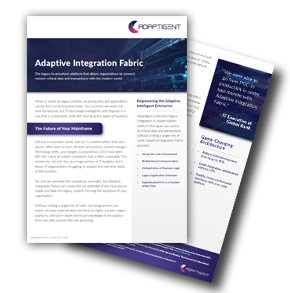
The Future of Your Mainframe
Adaptigent’s Adaptive Integration Fabric allows non-programers to rapidly create sophisticated interfaces to highly complex legacy systems through a visual, drag-and-drop environment. What used to take months or even years of coding can be done code-free in days or weeks, allowing you to keep up with the relentless pace of innovation your business demands.
Enterprise Integration Success Stories and Use Cases
Discover how organizations achieve faster time-to-market, improve operational efficiency, and realize significant cost
savings through no-code integration and API-driven modernization.
Airline Achieves $1B Cost Savings with Real-Time Integration
Life Insurer Boosts Engagement 70% and Saves $5M+
France Galop Deploys 80+ Web Services for Digital Platform
Let's Connect
If you're interested in expanding your capabilities around core systems, data integrations, and legacy technology, we should talk.
Frequently Asked Questions
How does Adaptive Integration Fabric integrate with legacy systems?
Adaptive Integration Fabric uses a visual, drag-and-drop interface and orchestration engine to create REST and SOAP APIs that connect legacy systems like mainframes to modern applications—without requiring changes to existing systems.
Does Adaptive Integration Fabric require coding?
No, Adaptive Integration Fabric is a no-code platform that allows users to build integrations and APIs without writing code, reducing complexity and accelerating development timelines.
What types of APIs and standards does Adaptive Integration Fabric support?
Adaptive Integration Fabric supports REST, SOAP, and OpenAPI standards, enabling organizations to expose legacy systems as modern, scalable API services.
How quickly can integrations be deployed with Adaptive Integration Fabric?
Integrations can move to production in days instead of months, helping organizations accelerate time-to-market and deliver new digital applications faster.
Can Adaptive Integration Fabric work with COBOL or PL/1 applications?
Yes, Adaptive Integration Fabric is designed to work with COBOL and PL/1 applications, allowing organizations to extend and integrate core systems without disrupting existing environments.